
100-hour iron-air batteries are being deployed. Four-hour Lithium ion has a competitor.
Tag: BESS
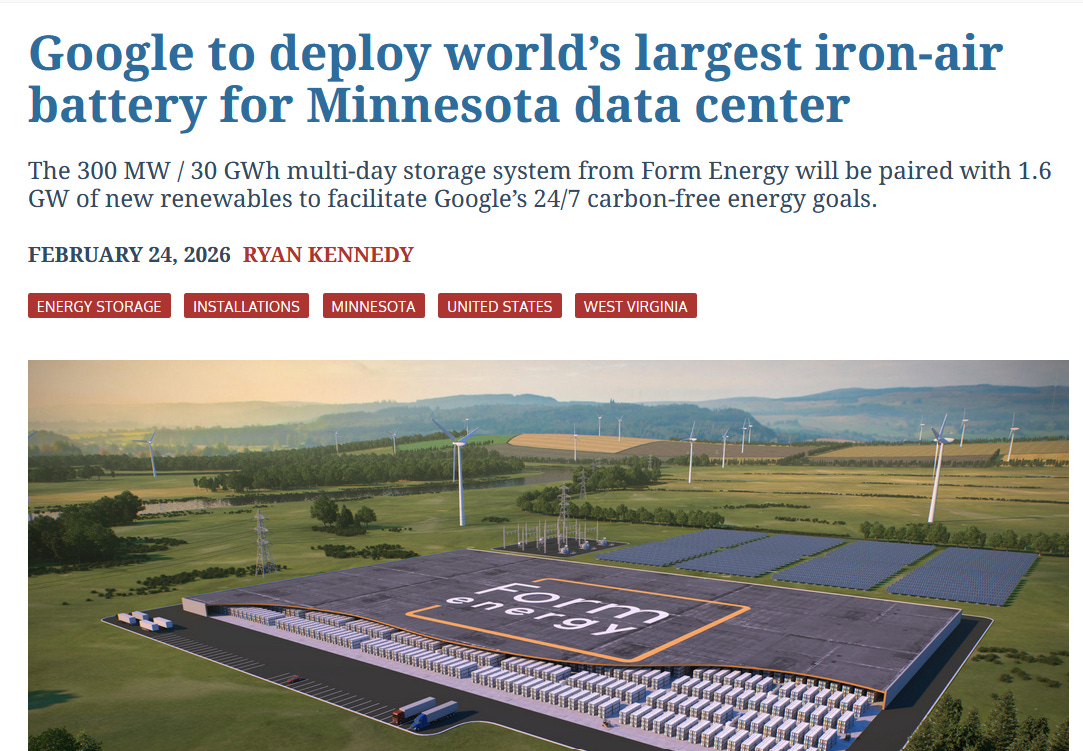
Click here to read the full article in PV Magazine
This Battery Energy Strorage System (BESS) is in the category Long Duration Energy Storage (LDES).
Here is a quote:
“While lithium-ion batteries are effective for 4-hour shifts, they cannot handle the multi-day storage. Form Energy said its iron-air batteries can store renewables-sourced electricity for 100 hours at system costs competitive with conventional power plants.”
Project developers should know these facts.
The manufacturer is Form Energy, formenergy.com
Form Energy is a young company with little track record. I consider them to be in the start-up phase, with the risks that come with new companies and new technologies. Investors, however, are companies with deep pockets.
Iron-air batteries are less energy dense than lithium ion batteries.
Iron-air batteries have lower Round-Trip Efficiency. Often in the range of 40% to 60%. The pro forma financial calculations will be far different from those for lithium ion at RTE of 85% to 90%.
I see only fuel-cost-free solar and wind energy as candidates for the source energy. Wasting energy with a zero marginal cost of kWh energy and kW demand means the energy input cost row is zero in the financial case of using batteries. In the base case of buying energy from the utility the cost of kWh and kW demand will come from a rate tariff or negotiated contract.
Iron-air batteries are non-flammable.
Form Energy’s product is designed for 100-hour storage.
This article does not quote a cost.
The factory is in the US, in West Virginia. A financial pro forma should include the Domestic Content bonus provided in the Inflation Reduction Act.
The article does not state the owner but the PPA contract implies it will be Xcel Energy, the local utility company.