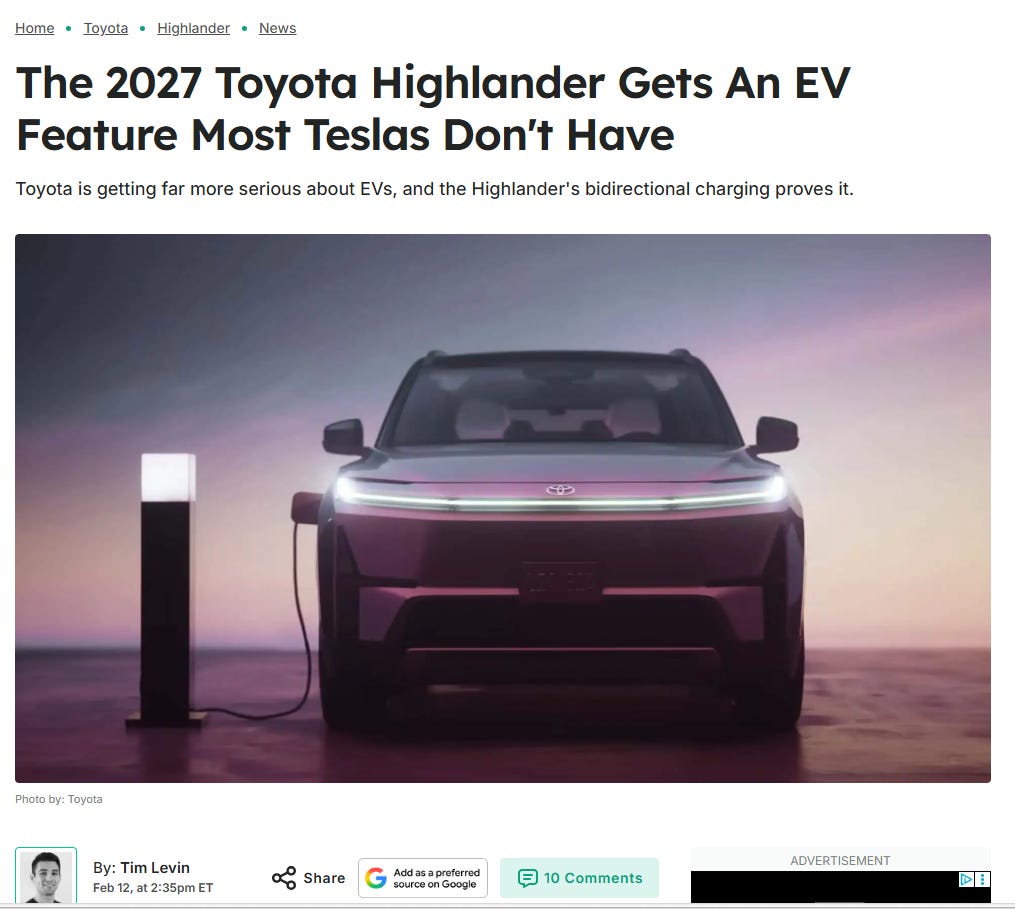
https://insideevs.com/news/787176/toyota-highlander-ev-bidirectional-charging-2026/
Many people are focused on power sources that feed the grid like the old central plants do in serving the aggregate load of all the customers.
In my Behind-the-Meter world building owners are using batteries to serve their loads, and using solar panels to add charge when the sun shines.
Batteries are expensive. One way to supplement a home battery is with an EV battery.
Home batteries are often 10 kWh to 25 kWh. EV batteries are often 60 kWh to 120 kWh or so.
If your home is wired for it you can connect your car and sell power from your car’s battery. Or you can provide yourself with more hours of outage protection.


Vehicle-to-grid is an interesting concept I suppose for some peak shaving. But realistically, I would like to see the economic benefits to the car/home owner.
It seems like there should be a premium paid to the battery owner for the luxury of drawing energy when the utility needs it.
I already have an 75 KW EV and a small solar system that can back feed to the grid. Luckily my state has a policy that requires the utility to compensate me at exactly the same rate as they charge me, so I get a payback without the additional cost of a battery pack.
I’m thinking as I type this, but if the utility wanted to draw, say 50 KW out of my car battery in the afternoon to handle a peak. It would net me about $6.50. Then I would probably have to pay $6.50 back to the utility that night so I would have sufficient charge for the next day. So it’s a no-sum game for me other than my battery is growing older a little faster every time the utility taps it.
I’m sure some additional equipment/meter would be necessary to make this work and someone would need to pay for that. I wouldn’t want to pay for it unless there was some other economic benefit to me.