https://spectrum.ieee.org/co2-battery-energy-storage
Here is an product that is at the point project developers look for. It solves a problem customers will pay to solve. The equipment is proven in use and available for purchase, but is early in the technology adoption cycle.
The lithium ion batteries in use today have a sweet spot of about 4 to 8 hours duration. The chemical process works well at that speed, and the economics work.
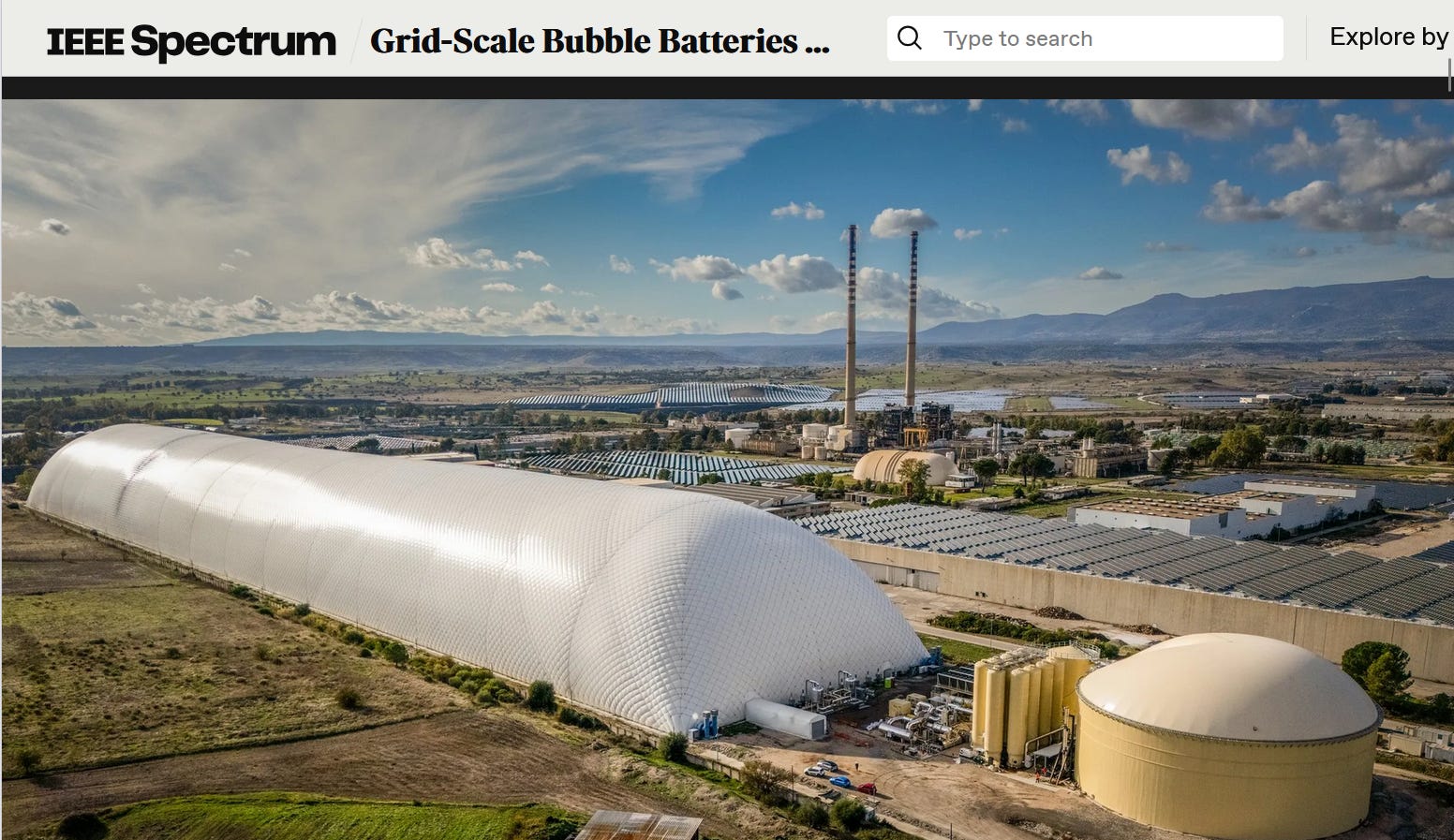
The plant in this photo produces 20 MW of power and has gas storage volume for 10 hours of use, so 200 MWh. Sunny Sardinia is a net exporter to the mainland and renewables are a significant fraction of the total generation capacity.
The IEEE Spectrum has an article with several links to supporting information. Here is what I have learned.
First, the business side.
There is a manufacturer, Energy Dome.
One unit has been built and is connected to the grid in Sardinia. More are in development by more than one customer in India and the US.
Google is a partner and has plans to build several units.
No new materials or equipment are required, what is new is the clever arrangement.
Construction is faster than its competitors in energy storage.
The manufacturer says the cost per unit of storage is less that its competitors.
The contract structure can be a purchase of the equipment, or Energy Storage as a Service.
Next the physics and engineering in the thermodynamics and fluid flow.
The storage medium is liquified carbon dioxide. The dome to the left contains carbon dioxide gas. The tanks to the right contain liquid carbon dioxide. The carbon dioxide is purchased from a supplier of industrial gases. This is not a carbon capture device.
The carbon dioxide moves from gas to liquid during storage. It moves from liquid to gas during generation.
The equipment in the middle is the compressors and condensers to liquify the gas during storage, and the evaporator and turbine which generate electricity.
Carbon dioxide can be liquified using a high pressure with no mechanical cooling required.
The process gives up heat during compression, and requires heat during expansion. The article mentions a thermal energy storage system.
Here is a quote from the article:
“Outside the dome, a series of machines connected by undulating pipes moves the CO2 out of the dome for compressing and condensing. First, a compressor pressurizes the gas from 1 bar (100,000 pascals) to about 55 bar (5,500,000 pa). Next, a thermal-energy-storage system cools the CO2 to an ambient temperature. Then a condenser reduces it into a liquid that is stored in a few dozen pressure vessels, each about the size of a school bus. The whole process takes about 10 hours, and at the end of it, the battery is considered charged.”

