
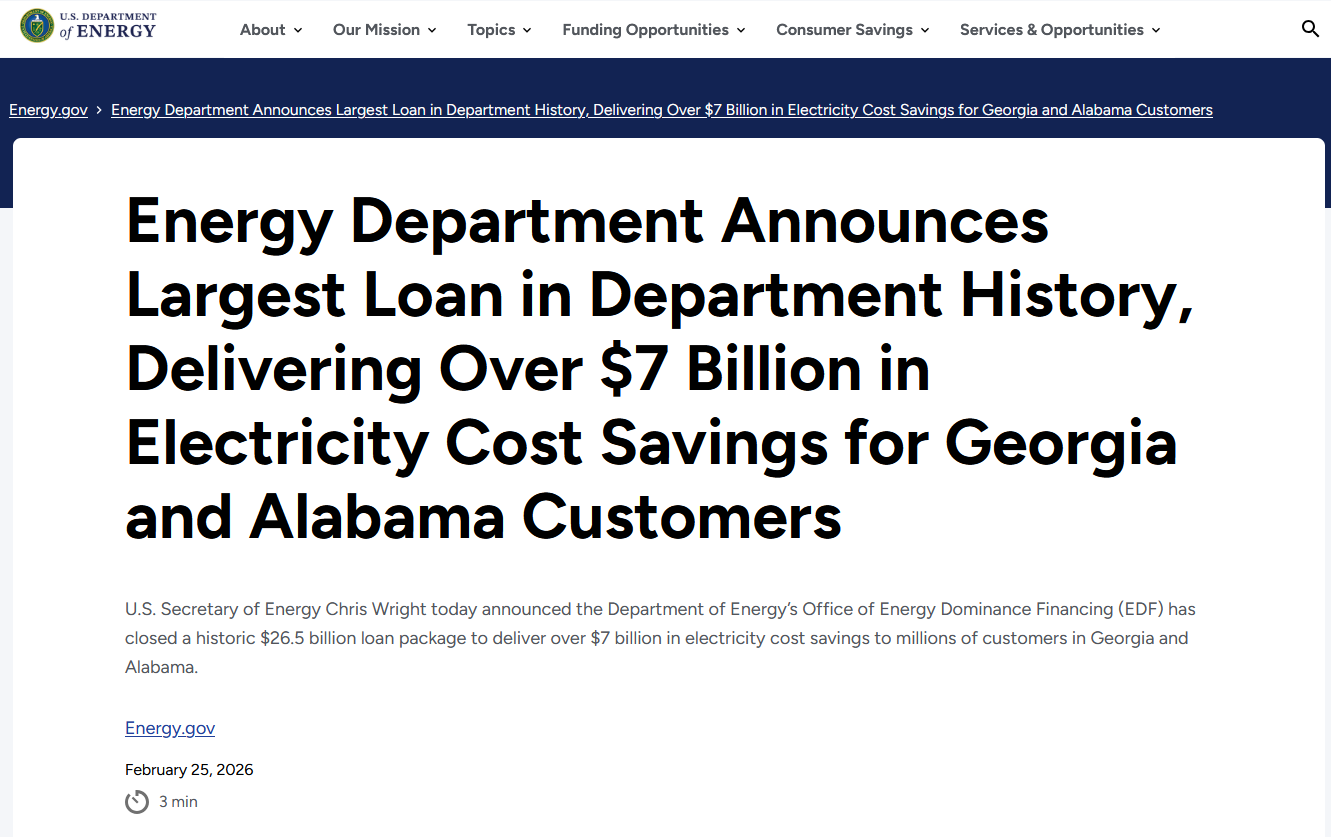
https://www.energy.gov/articles/energy-department-announces-largest-loan-department-history-delivering-over-7-billion
I don’t see how $300 million per year in interest savings on Southern Comany’s books translates to $7 billion savings for consumers, but I guess that is the nature of press releases.
I can calculate a rule of thumb. The $26.5 billion gets us 16 GW of new capacity. That works out to $1.65 billion per GW, or $1656 per MW. My old rule of thumb was $1000 per MW for new generation.
The list looks mostly like routine replacement of capital equipment that will provide no new capacity. Hopefully Southern Company already had a plan for replacement of equipment as it reaches the end of its useful life.
Secretary Wright always emphasizes that a grid’s primary function in his mind is to meet the peak load. He speaks derisively of solar and wind sources of electricity, which save fuel which is needed during times of peak generation if they happen to occur when photons are not available for photovoltaics or wind kinetic energy is not available.
On many summer days photovoltaics produces electricity at the peak in the afternoon. On many winter nights wind energy produces at the peak during the night. In Texas, we credit solar-sourced electricity as the key to getting through the summer of 2025 with no emergencies.
Secretary Wright’s position for electricity emphasizes sources that are dependent on fuel. His position on oil and gas production emphasizes we export it. Many of us who lived through the embargo of 1973 when the US was a buyer of oil think saving fuel is good for national security and serves American citizens well.
It appears to me that battery storage is now been grouped as “firm reliable power” even if solar and wind are left out.
Here is a quote from the press release.
“The two loans will build or upgrade over 16 gigawatts (GW) of firm reliable power to the electrical grid. This includes 5 GW of new gas generation, 6 GW in nuclear improved through uprates and license renewals, hydropower modernization, battery energy storage systems and over 1,300 miles of transmission and grid enhancement projects.
These loans represent the largest government investment aimed at directly lowering consumer energy costs and increasing grid reliability. Once all funds are received through the program, the loans are estimated to reduce Southern Company’s interest expenses by over $300 million per year, helping expedite lower electricity costs for customers.”