One source for information on the status and future of the EV charger market is the quarterly publication “Get Connected” from the Alliance for Automotive Innovation. The Alliance is a trade group of car and car parts manufacturers. The members of this group have a strong interest in the status of the EV charger network to support their EV products.
The 27-page Fourth Quarter 2025 issue of Get Connected is available here:
The section on chargers starts on page 15.
The two types of chargers tracked are DC Fast Charging, and Level 2 Charging.
The cost for charging
This quote mentions cost per kWh. The report cites it sources.
“Cost remains a parallel concern. Multiple analyses find that charging away from home – particularly via DC fast chargers – costs two to three times more per kilowatt-hour than residential charging, with average home rates around $0.17–$0.18/kWh compared with $0.40–$0.50/kWh or higher for public fast charging in many regions. These higher costs are driven by capital expenses, utility demand charges, and limited competition at many charging sites.”
Location of the cars
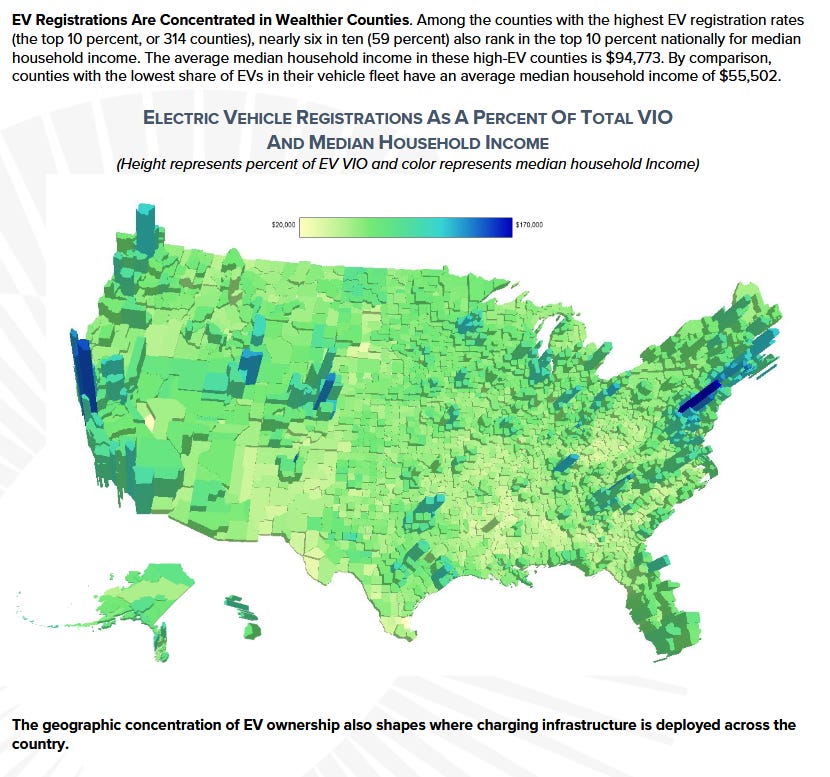
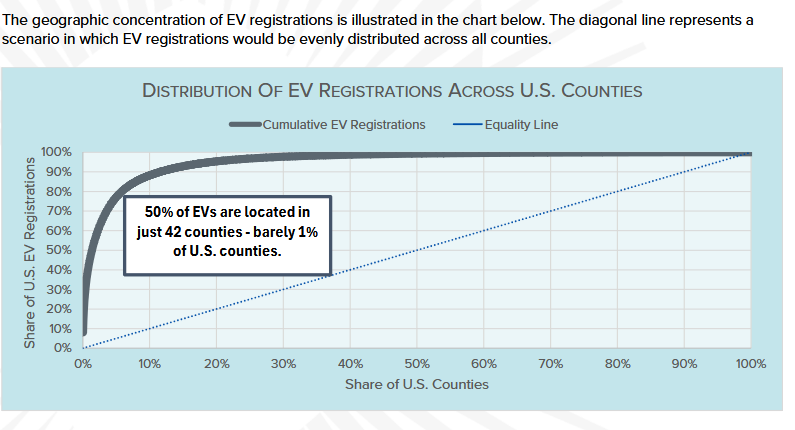
The locations that are most likely to need chargers are where the cars are. They are concentrated in a few wealthy counties.
How few? 42.
How wealthy and where? The chart below uses a county map with a tower shape for each county. Where the cars are is shown on the map by percent EV ownership as the height of county’s tower, and the income by its color.