
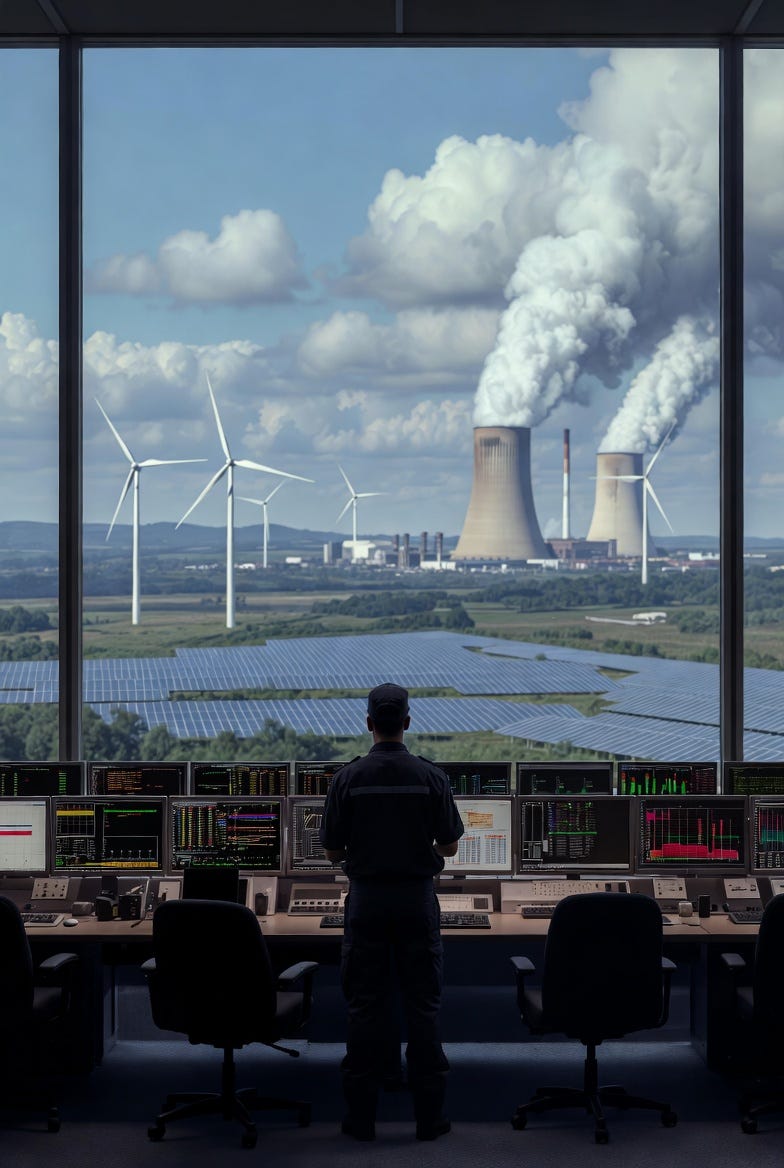
Image by Grok
I participate in a discussion group about the news of the day. When electricity sources are in the news I point out that the main additions for the next few years are solar, batteries, and wind. I express my support for these additions.
Recently I was challenged to explain why I support solar and wind. The question was about the endgame I was pursuing. Here is my answer.
I want to address the endgame for supporting solar and wind.
You point out that the UK has to import natural gas and electricity. Any solar-sourced and wind-sourced electricity they can come up with will require no import and no subservience to the supplier country.
I was in college during the Arab Oil Embargo of 1973. We were importing 50% of our oil from the Middle East because it was inexpensive. They knew they could hurt us and they did it. It hurt.
Both solar photovoltaics and today’s tall wind turbines were developed as a result of the push to get away from foreign suppliers and the high prices during oil and gas shortages. Those reasons still exist. (Ethanol as a domestic fuel to stretch gasoline supplies was developed then, too. Lots of other ideas were tried and not kept active.)
One person on X calls solar and wind fuel-savers and not sources of generation. I accept that filter, and say that is a pretty good contribution to society - saving fuel by generating electricity some other way than burning fuel. When Texas can get 40% of its electricity from solar and wind, its natural gas can go into storage for winter. The rhythm of the natural gas business is that gas produced in the summer goes into storage for the winter. One metric published in the natural gas business is the amount of gas in storage at the beginning of the winter. It varies from year to year. Finding ways to store more gas each year is a good thing.
Many of the storage sites are large caverns in the upper Midwest. So Texas can send more gas in the summer up to people who use it to heat their homes and generate electricity. I think everyone up North where the ground freezes and snow just sits there for a couple of months appreciates the supply. I used to live in such a place.
I see the trend to solar and wind, with their advancements in the underlying power electronics and internet communications, as logical additions to the grid just because of the economics and the management possibilities. Utility companies appreciate the addition of Distributed Energy Resources in the form of mostly solar and batteries at customer sites. Which side is “behind the meter” is starting to blur.
Getting from the primary energy to electricity is just simpler when there is no fuel delivery system. For solar and wind, the primary energy comes from nature at no cost and arrives on its own. That seems to be a concept that few people are on board with as an advantage. I know that people who sell natural gas, coal, and nuclear fuel are not too crazy about their industry being bypassed but I think the laws of economics and physics are against them.
I know that the photons don’t always arrive and the wind’s kinetic energy does not always arrive. All the designers and buyers of systems know that, too. What the grid operators do is to use the other sources available at the time, which are usually nuclear, gas, coal, hydro and now a few batteries. This systems approach has been used successfully for decades in Texas, California, New England, and Spain that I have studied. Grid operators have more tools when the number of sources increases. Risk is reduced. Reliability is enhanced.
None of the generators work when fuel does not arrive. All need to be taken out of service for maintenance. Redundancy of equipment is a basic principle in design of many systems that must keep running in factories and large buildings. It is not unique to solar and wind.
Two nuclear plants were down at the same time in New Orleans in May 2025, causing an outage. It got little publicity outside New Orleans. There is no solar or wind in their system so renewables had nothing to do with it. Nashville is in the news with a multi-day outage and TVA has next to no solar or wind, and their generators were not down.
My summary is that solar and wind are cost-effective, recent innovations and domestic sources. They are used in a systems approach. The grid is already moving to a strategy with a group of batteries that smooth out the inputs of energy from all sources. That will make fossil-fuel sources more efficient by running at a steady rate and at their efficiency sweet spot. Fuel-free solar and wind energy can be absorbed when available and released when needed. Many of the batteries are now and in the future will be at customer sites, even homes, and provide outage protection and possibly a source of income by participating in a Virtual Power Plant.
We will keep burning fuel for a long time. New nuclear and deep-well geothermal will probably move out of the development stage to the commercial use stage, announced by both to be in the 2030s. That is fine by me.
I appreciate that the logistics and technicalities of deep geothermal are more complex than they appear and go beyond my limited knowledge, but on the face of it, it's always seemed a frustratingly underdeveloped option. We talk about how drilling a deep hole and harnessing the heat of the earth is a difficult thing to do, but we are *literally* splitting the atom as an alternative. So many of our energy sources (all - bar photovoltaic?) rely on spinning a coil of wire and magnets, usually using steam and a turbine - yet here we are sat on top of a ball of molten magma that surely could boil some water if we supplied the same time, energy and funding that has been ploughed into the oil and gas industry?